RevenueNSW
How might we increase customer confidence and acceptance that a fine was issued correctly?
Role
Lead Experience Designer
Industry
Government
Duration
3 months

Overview
RevenueNSW partnered with PwC to design a minimum viable product that would increase customer access to consistent, timely, and better-quality information about their fine, while using alert systems to prompt behaviour change toward earlier resolution.
In FY2020-21, over 3.4 million fines were issued across New South Wales with a total face value of nearly $897 million, with approximately 22% of recipients not resolving promptly.
I led discovery, research, and design across the full engagement, from customer focus groups through to a clickable MVP prototype presented to the RevenueNSW executive team.
The challenge
The original brief had a clear assumption baked into it: if customers could see photographic evidence of their offence, they would be more likely to accept it. It was a reasonable starting point. It was also incomplete.
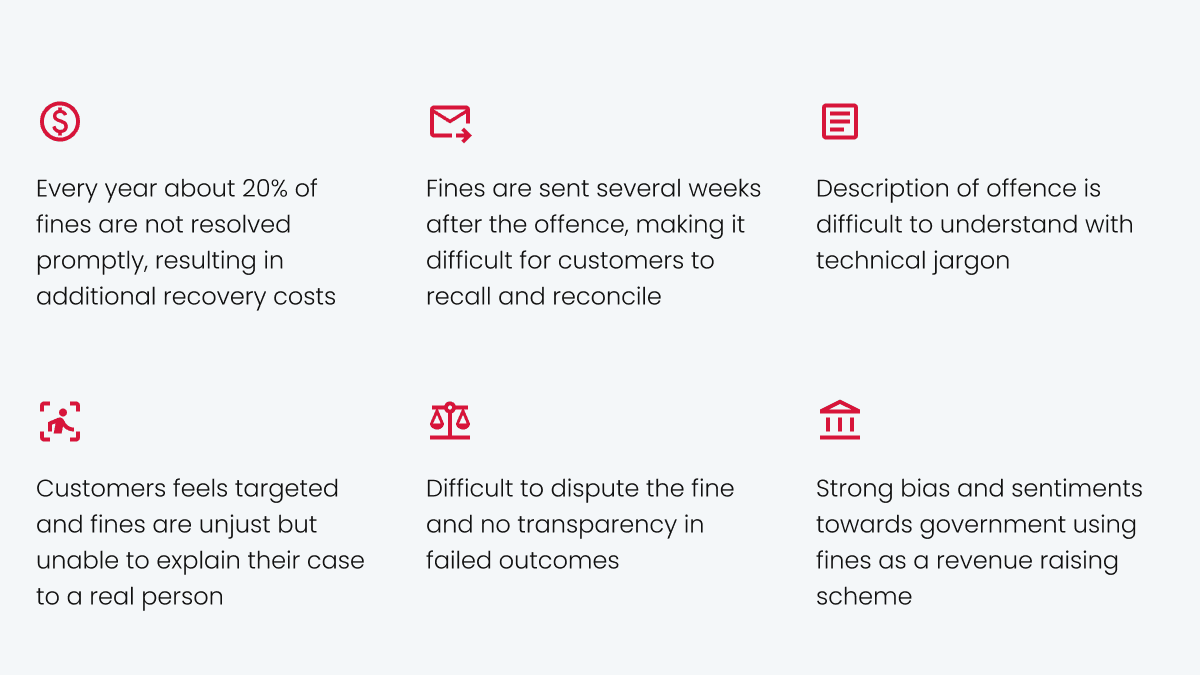
Through research and collaboration with an in-house behavioural expert, it became clear that acceptance was not a visibility problem. It was a trust problem, and the barriers to trust were spread across the entire fine lifecycle: how a fine was issued in the field, how long it took to arrive, and whether customers could understand what they were reading when it did.
Solving this required designing across multiple touchpoints simultaneously, not improving a single notification. Within the 22% not resolving promptly, two distinct groups emerged: those who genuinely could not pay, who needed support and clear pathways, and those who were choosing not to, often out of frustration or confusion rather than deliberate avoidance.
My role
I was the lead experience designer across the full project, planning and facilitating all customer research, issuer interviews, and stakeholder workshops, synthesising findings into insights, defining current and future state journey maps, designing wireframes and the clickable MVP prototype, and presenting the work to the RevenueNSW executive team. A UX designer co-facilitated research and assisted with synthesis. A UI designer joined mid-project to develop the issuing officer screens under my direction.

The turning point
Discovery across three groups
Before the solution could take shape, the research had to challenge the brief. Discovery covered 29 customers across five fine types in focus groups and 1:1 interviews, issuing officers across city councils, NSW Police, and Transport for NSW, and 20 government stakeholders across RevenueNSW and ServiceNSW. Sessions were recorded with consent and synthesised in Dovetail, where transcripts were tagged to surface patterns across the full fine lifecycle.
Four consistent themes came back from customers. They wanted human contact at a moment that felt adversarial and impersonal. Timing mattered: receiving a notice within a week of the offence helped with memory recall and gave people enough time to act. The jargon on physical notices was creating disputes that clearer language could have prevented. And customers had almost no understanding of the dispute process or their rights within it.
"I find the actual offence wording quite confusing. What does it actually mean? It's obviously like the jargon, but yeah, it's confusing." — Customer, traffic fines focus group
"I'm paying over a hundred dollars and I actually want to speak to someone who can listen to my situation and make a decision. Not just navigate a system." — Customer, parking fines focus group

Reframing the problem
Working with the behavioural expert, the EAST framework, Easy, Attractive, Social, and Timely, pushed us to strip the solutioning out of the original problem statement. The brief had assumed photographs would solve the acceptance problem. The research and the EAST lens made clear that acceptance was a behaviour change challenge, and the real levers were timeliness, language clarity, evidence quality, and giving customers a genuine sense of agency throughout the process.
Instead of designing a better notification with a photo attached, we were designing a system that reached customers at the right moment, through the right channel, with the right information, to make resolution the easiest and most obvious next step.


Designing the experience
Issuing officer experience
Developed under my direction, the issuing officer experience introduced standardised documentation tools and communication templates to reduce variation in how fines were issued and explained at the point of contact, addressing the inconsistency problem at its source.
Digital notification
The MVP proposed notifying customers through the ServiceNSW app within 72 hours of issuance, surfacing offence details, photographic evidence, plain language legislation, and clear calls to action: pay, dispute, nominate another driver, set up a payment plan, or request a hardship review. ServiceNSW was chosen because research confirmed strong existing adoption, making it a trusted touchpoint rather than a new system to learn.

Redesigned the physical notice
The existing physical notices were dense with legal jargon that was generating disputes better communication could have prevented. The redesigned notice strips back to plain language, presents evidence clearly, gives customers explicit options for next steps, and provides a direct path to the digital experience for resolution.
Supporting customers who cannot pay
Within the 22% not resolving promptly, two groups needed entirely different design responses.
Customers who could not pay needed visible, low-friction pathways to payment plans and hardship support.
Customers who would not pay needed timely, credible, evidence-based communication to shift their behaviour.
Nudge prompts and reminders were built into the fine lifecycle using EAST principles, placed at the moments when each group was most likely to act.


Impact
Before
3.4 million fines issued annually worth $897 million, 22% of recipients not resolving promptly, no customer guidance through the fine lifecycle, and physical notices so hard to understand they were generating disputes that clearer communication could have prevented.
After
A validated MVP prototype and executive-endorsed roadmap giving RevenueNSW a technically feasible, behaviourally informed path to redesigning how the NSW Government communicates with millions of people about one of the most consequential interactions they will have with the state.
The engagement did not reach build. It delivered a clear, evidence-based direction for redesigning how millions of people experience the fine system, backed by research across 29 customers, 12 issuing officers, and 20 government stakeholders.
~$10m revenue
From a 5% behaviour shift in non-paying groups
>$6m saved
YoY from sending fine reminders
10% increase
In payment after first notification
>$1.4m saved
From 25% reduction of call centre contacts